Who Will Become the Next Senior?Generative AI appears to be absorbing not just specific categories of tasks, but parts of the pathway through which the next generation of seniors is formed.생성형 AI는 특정 범주의 업무만이 아니라, 다음 세대의 시니어가 형성되는 경로의 일부까지 흡수하고 있는 것으로 보인다.
Sumin Yu · Taesup MoonElectrical & Computer Engineering, Seoul National University서울대학교 전기·정보공학부
The decline of junior hiring is commonly read as job displacement.주니어 채용의 감소는 흔히 ‘일자리 대체’로 읽힌다.
Tools like GitHub Copilot, ChatGPT, and Claude now perform substantial portions of the code generation, debugging, and documentation that were frequently assigned to entry-level engineers. Concurrently, junior developer hiring has contracted sharply. These trends are commonly read as job displacement — the efficient substitution of human labor with automated tools, accompanied by corresponding adjustments in headcount.GitHub Copilot, ChatGPT, Claude 같은 도구는 이제 한때 신입 엔지니어에게 자주 맡겨지던 코드 작성·디버깅·문서화의 상당 부분을 대신한다. 그와 동시에 주니어 개발자 채용은 급격히 줄었다. 이 흐름은 흔히 일자리 대체, 즉 자동화 도구를 통한 인간 노동의 효율적 대체와 그에 따른 인원 조정으로 읽힌다.
−25%
Entry-level postings at the 15 largest U.S. tech firms, 2023→2024미국 대형 기술기업 15곳의 신입 채용 공고, 2023→2024
Brynjolfsson 2025
−27.5%
U.S. programmer employment, 2023→2025미국 프로그래머 고용, 2023→2025
Rak 2025
51.8%
Korea's work-related AI use — nearly double the U.S. rate한국의 업무 관련 AI 사용률, 미국의 약 2배
BOK 2025
4.4%
Share of Korean IT postings that were entry-level (postings fell 43%)한국 IT 공고 중 신입 비중 (공고 자체는 43% 감소)
ChosunBiz 2025
We do not dispute that this displacement is occurring. We would argue, however, that the tasks currently being absorbed by GenAI — minor bug fixes, routine implementation, debugging — are not simply entry-level tasks that organizations can eliminate without further issues and concerns.이러한 대체가 일어나고 있다는 사실 자체를 부정하는 것은 아니다. 다만 본 연구는, 지금 GenAI가 흡수하고 있는 업무, 즉 사소한 버그 수정·반복적 구현·디버깅이 조직이 아무 문제 없이 없애도 되는 단순한 신입 업무가 아니라는 점을 지적한다.
What GenAI is absorbing is the developmental scaffolding through which juniors grow into seniors.GenAI가 흡수하는 것은, 주니어가 시니어로 자라나게 하는 성장의 발판이다.
What GenAI is absorbing is the developmental scaffolding through which juniors grow into seniors: the early stages of an apprenticeship-based development pathway, where juniors learn through real-world experience alongside more experienced developers, and expertise is passed down from one generation to the next.GenAI가 흡수하는 것은 주니어가 시니어로 자라나는 성장의 발판(developmental scaffolding)이다. 이는 도제식 성장 경로의 초기 단계, 즉 주니어가 더 숙련된 개발자 곁에서 실제 경험을 통해 배우고 전문성이 한 세대에서 다음 세대로 전수되는 단계에 해당한다.
When this scaffolding is absorbed, what may disappear is not only entry-level employment but also the very mechanism through which the next generation of seniors — skilled professionals — is formed.이 발판이 흡수될 때 사라질 수 있는 것은 신입 일자리만이 아니다. 다음 세대의 시니어, 곧 숙련된 전문가가 만들어지는 메커니즘 자체다.
Building on the macro-level hiring decline documented in numerous quantitative analyses, the contribution of our study lies not in confirming this phenomenon but in identifying its underlying mechanism and the factors contributing to its persistence.수많은 정량 분석이 이미 거시적인 채용 감소를 기록해 왔다. 본 연구의 기여는 이 현상을 재확인하는 데 있지 않고, 그 아래에 놓인 메커니즘과 그것이 지속되는 요인을 규명하는 데 있다.
Semi-structured interviews with 14 software engineers소프트웨어 엔지니어 14인 반구조화 인터뷰
We recruited 14 participants: eight juniors (J1–J8), defined as individuals within two years of completing an undergraduate ECE/CS degree, at the threshold of entering the workforce; and six seniors (S1–S6), professionals with at least six years of industry experience, drawn from diverse organizational contexts. Interviews were conducted in Korean and analyzed using Reflexive Thematic Analysis.본 연구는 주니어 8명과 시니어 6명, 총 14명을 대상으로 했다. 주니어(J1–J8)는 전기·컴퓨터공학(ECE)이나 컴퓨터과학(CS) 학부를 마친 지 2년 이내로, 취업을 앞둔 이들이다. 시니어(S1–S6)는 다양한 조직에서 일하는 6년 이상 경력의 전문가다. 인터뷰는 한국어로 진행하고 성찰적 주제 분석(Reflexive Thematic Analysis)으로 분석했다.
Rather than serving as a representative national case, South Korea functions as an important critical case in which these dynamics emerge earlier and more clearly: work-related AI usage reaches 51.8%, almost double the U.S. rate; open recruitment has collapsed; and Korea's labor market structures displace adjustment costs onto labor market entrants rather than incumbent workers.한국은 대표적 국가 사례가 아니라, 이 역학이 비교적 이른 시기에 선명하게 나타나는 결정적 사례(critical case)다. 업무 관련 AI 사용률이 51.8%로 미국의 약 두 배에 이르고, 노동시장 구조가 조정 비용을 기존 인력이 아니라 신규 진입자에게 전가하는 경향이 있기 때문이다.
A foundational pattern of Absorption — and three consequences핵심 양상 ‘흡수’, 그리고 세 가지 결과
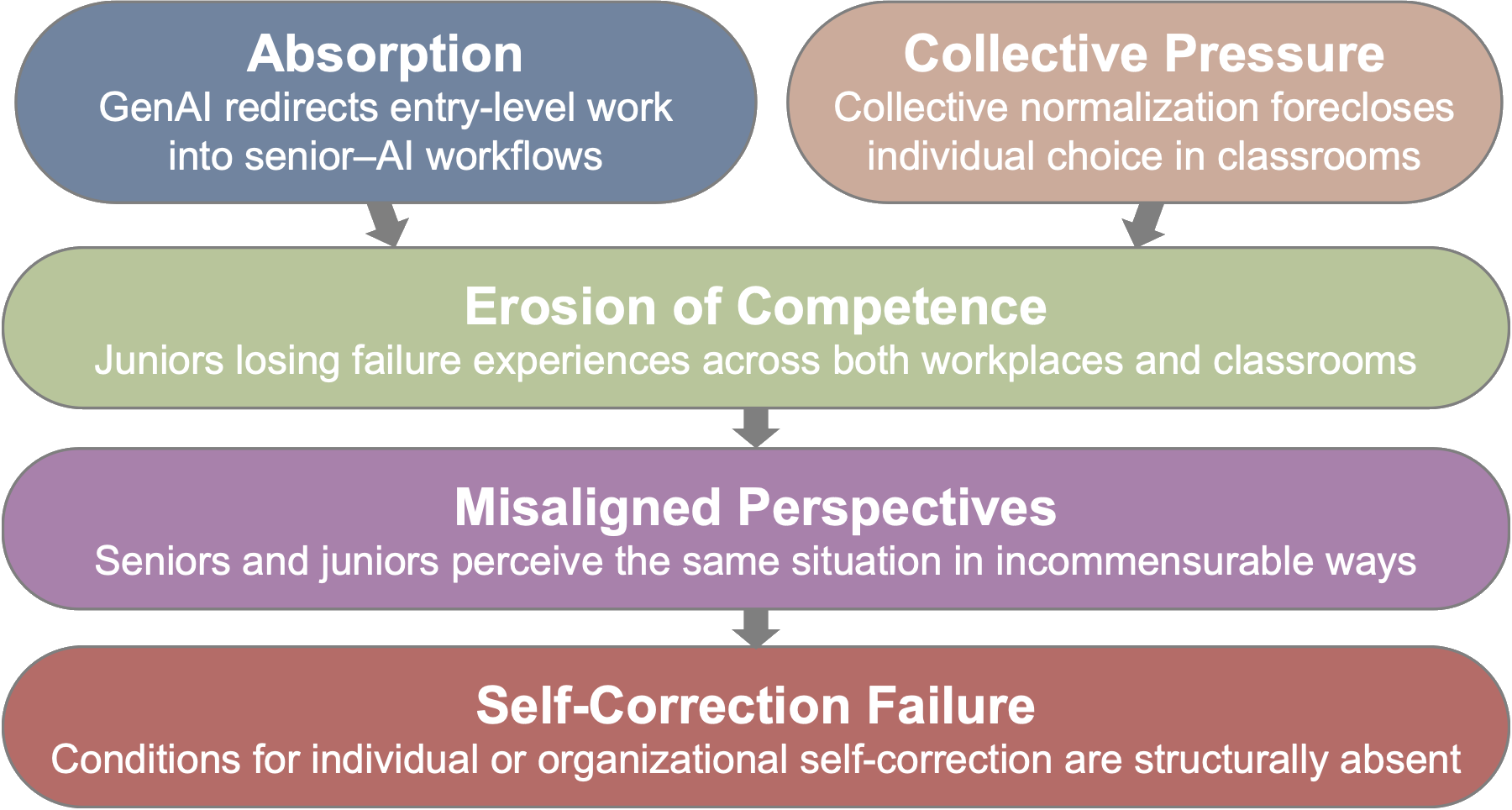
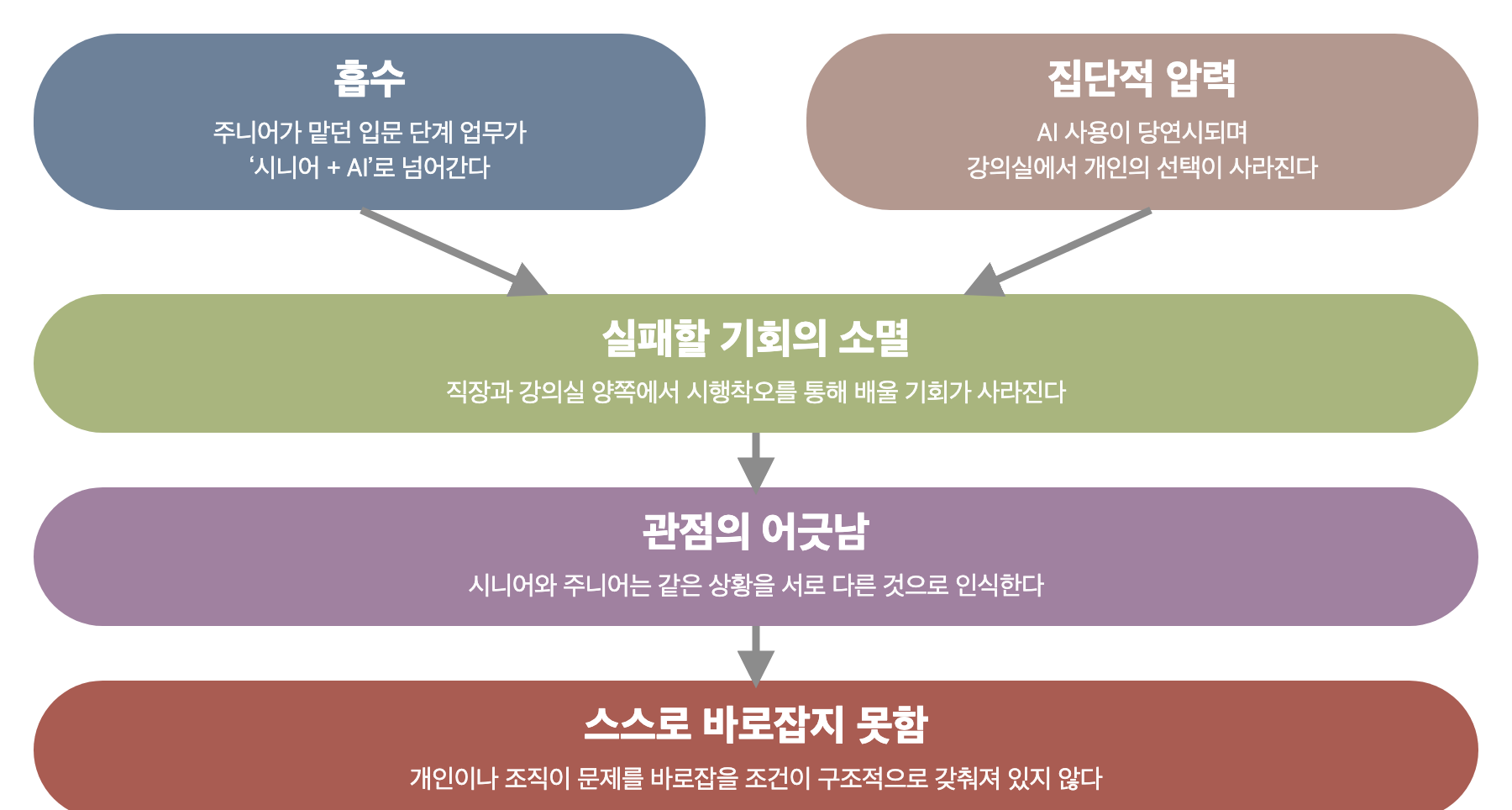
Empirically, we identify a foundational pattern of Absorption: GenAI redirects entry-level work into senior–AI workflows. From this pattern, three consequences follow, as the diagram below summarizes.본 연구가 실증적으로 확인한 핵심 양상은 흡수(Absorption), 즉 GenAI가 신입 업무를 시니어–AI 워크플로로 재배치하는 것이다. 이 양상에서 세 가지 결과가 뒤따르며, 아래 그림이 이를 요약한다.
Figure 2 — Absorption and collective pressure produce the erosion of competence through lost failure experiences; misaligned perspectives prevent self-correction. — 흡수와 집단적 압력이 실패 경험의 소실을 통한 역량의 침식을 낳고, 관점의 어긋남이 스스로 바로잡는 것을 가로막는다.
Absorption of junior opportunities into senior workflows주니어의 기회가 시니어의 워크플로로 흡수되다
A foundational pattern observed across senior participants was that GenAI tools had dramatically expanded their individual capacity, enabling them to handle tasks that would previously have been delegated to others, particularly entry-level engineers. This had a direct structural consequence: the entry-level work that had historically provided learning opportunities for entry-level engineers was no longer reaching them.시니어 참여자들에게서 공통으로 나타난 핵심 양상은, GenAI 도구가 개인의 처리 능력을 크게 키워 이전이라면 다른 사람에게, 특히 신입 엔지니어에게 맡겼을 일을 직접 해내게 됐다는 것이다. 이는 직접적인 구조적 결과로 이어졌다. 오랫동안 신입에게 배움의 기회가 되어 주던 신입 업무가 더 이상 그들에게 닿지 않게 된 것이다.
“What can a junior engineer do better than a 100,000-won Claude subscription? I don't think there's anything.” (S4)“주니어 엔지니어가 10만 원짜리 Claude 구독보다 더 잘하는 게 뭐가 있죠? 없는 것 같아요.” (S4)
Having significantly reduced his junior headcount over the last year, S4 observed that their departure had had no measurable impact on productivity. This perspective was not unique to him: among senior participants (S1–S6), it was consistently observed that AI tools had effectively absorbed the more routine, lower-complexity tasks — e.g., code generation, initial debugging, and documentation. As S5 put it: “These days, things are being replaced so quickly that juniors are increasingly not being given the opportunity to do those things.”지난 한 해 주니어 인원을 크게 줄인 S4는, 그들이 떠난 뒤에도 생산성에 측정 가능한 영향이 전혀 없었다고 말했다. 이는 그만의 생각이 아니었다. 시니어 참여자들(S1–S6) 사이에서, AI 도구가 비교적 반복적이고 복잡도가 낮은 업무, 곧 코드 작성·초기 디버깅·문서화 등을 사실상 흡수했다는 관찰이 일관되게 나타났다. S5의 말처럼, “요즘은 대체가 너무 빨라서, 주니어들이 그런 일을 해 볼 기회 자체를 점점 못 받아요.”
Erosion of competence through lost failure experiences실패 경험의 소실을 통한 역량의 침식
A central finding for both junior and senior participants was that, as they began using GenAI — whether in school or at work — failure no longer served as a source of learning. As GenAI absorbed the lower-complexity tasks that once characterized early-career workflows, the productive struggle embedded in those tasks also disappeared. All junior participants (J1–J8) noted that they could now achieve good results easily, without the struggle they once experienced; what emerged in its place was output without understanding.주니어와 시니어 모두에게서 나타난 핵심 발견은, 학교에서든 직장에서든 GenAI를 쓰기 시작하면서 실패가 더 이상 배움의 원천이 되지 못했다는 점이다. GenAI가 초기 경력의 낮은 복잡도 업무를 흡수하면서, 그 안에 존재하던 생산적 분투(productive struggle)도 함께 사라졌다. 주니어 참여자 전원(J1–J8)이 예전처럼 힘들여 애쓰지 않아도 좋은 결과를 쉽게 얻게 됐다고 말했고, 그 자리를 대신한 것은 이해 없는 산출물이었다.
“I don't know what not to do. I've only seen the good examples, so I don't know what the bad ones look like.” (J6)“뭘 하면 안 되는지를 몰라요. 좋은 예시만 봤으니까, 나쁜 게 어떤 건지를 모르는 거죠.” (J6)
J1 put the same problem more starkly: “I don't know what I don't know.” And J8 put it most vividly:J1은 “제가 뭘 모르는지를 몰라요.”라며 더 날카롭게 표현했다. J8은 이를 가장 생생하게 보여 준다.
“There were things I was presenting that I didn't understand myself. I was thinking, 'Is this even right?' — and I hadn't even checked, because there was no time.” (J8)“제가 발표하는 내용 중에 저조차 이해 못 한 게 있었어요. '이게 맞나?' 싶었지만, 확인도 못 했어요. 시간이 없어서요.” (J8)
Taken together, these accounts reflect what Kapur's theory of Productive Failure would suggest: when learners are shielded from the imperfect, effortful attempts they must endure to achieve mastery, they not only lose knowledge but also the ability to recognize the boundaries of their own competence. Bjork's concept of desirable difficulties makes the parallel point: the conditions that appear to slow progress — struggling, failing, and revising — produce durable and transferable learning. By eliminating these conditions, GenAI yields what J4 described as a distinct difference between two university courses covering the same subject:이 진술들을 종합하면 Kapur의 생산적 실패(Productive Failure) 이론이 예측하는 바가 드러난다. 학습자가 숙달에 이르기까지 거쳐야 할 불완전하고 힘든 시도로부터 차단되면, 지식뿐 아니라 자기 역량의 한계를 인식하는 능력까지 잃는다는 것이다. Bjork의 바람직한 어려움(desirable difficulties) 개념도 같은 지점을 짚는다. 분투하고 실패하고 고쳐 쓰는, 다소 더디게 보이는 과정이야말로 오래가고 전이되는 학습을 낳는다. GenAI가 이 조건을 없앤 결과는, 같은 분야를 다룬 두 수업(머신러닝·딥러닝)을 비교한 J4의 경험에서 확인할 수 있다.
“My grades came out the same. But the growth I felt — I definitely studied much more in the machine learning course. The deep learning course just felt like I got better at using GPT.” (J4)“성적은 똑같이 나왔어요. 그런데 제가 느낀 성장은 — 머신러닝 수업에서 훨씬 많이 공부한 게 확실해요. 딥러닝 수업은 그냥 GPT를 더 잘 쓰게 된 느낌이었어요.” (J4)
The students, the academic field, and the evaluation criteria are all the same; the only difference is whether the assignment can be completed using GenAI. The grade-equivalent outcomes are what make the case analytically significant: they show that the institutional signal of learning — the grade — can remain stable while what is actually learned diverges sharply. In one course, the work produced durable domain knowledge; in the other, only fluency in operating a tool. Here, the current assessment structure in education fails to identify that difference.학생도, 학문 분야도, 평가 기준도 모두 같다. 유일한 차이는 과제를 GenAI로 완성할 수 있느냐였다. 성적이 동일하게 나왔다는 점이 이 사례에서 주목할 부분이다. 학습을 나타내는 제도적 지표인 성적은 그대로인데, 실제로 배운 것은 크게 갈렸음을 보여 주기 때문이다. 한 수업에서는 오래가는 전공 지식이 남았고, 다른 수업에서는 도구를 다루는 능숙함만 남았다. 지금의 교육 평가 구조는 그 차이를 포착하지 못한다.
Notably, junior and senior participants — standing at opposite ends of the experience spectrum — used nearly identical phrasing, “knowing what should not be done,” to describe the missing competency:주목할 점은, 많은 경험을 쌓은 시니어들 또한 사라진 이 역량을 거의 같은 말로 짚었다는 것이다. 바로 “무엇을 하면 안 되는지를 아는 것”이다.
“The reason someone is called a senior is that they know how work should not be done — but now juniors can't learn from the bad examples.” (S6)“시니어라고 불리는 이유는 일을 어떻게 하면 안 되는지를 알기 때문이에요. 그런데 지금 주니어들은 나쁜 예시로부터 배울 수가 없어요.” (S6)
Moreover, what people can do in workplaces is fundamentally related to the skills formed by this failure process. S5, a senior engineer at a mid-sized company, described this point as follows:나아가 직장에서 실제로 무엇을 해낼 수 있는지는, 이 실패 과정에서 길러지는 역량과 직결된다. S5는 이 점을 이렇게 설명했다.
“The cost of code generation is so cheap using GenAI, but the cost of code verification is so expensive.” (S5)“GenAI로 코드를 생성하는 비용은 너무 싸요. 그런데 코드를 검증하는 비용은 너무 비싸요.” (S5)
Such verification — knowing what is wrong, what does not work — is the human skill that failure-based learning produces. Yet juniors, by being shielded from failures, are no longer developing it. GenAI accelerates output production while eroding the very experiences through which juniors would learn to evaluate that output.코드 검증, 즉 무엇이 틀렸고 무엇이 작동하지 않는지를 아는 능력은 실패 기반 학습이 길러 내는 역량이다. 그러나 주니어는 실패로부터 차단되면서 그 능력을 더 이상 기르지 못한다.
Collective pressure as a barrier to productive struggle생산적 분투를 가로막는 집단적 압력
Why is productive struggle being eliminated in the first place? This is not due to individual choice, but rather stems from a structural dynamic that operates within the educational environment itself. A consistent pattern across junior participants was that the use of GenAI in university coursework is no longer a matter of personal choice. It had become the norm for most students — meaning individual students found it difficult to resist using GenAI, regardless of their own intentions.애초에 생산적 분투는 왜 사라지고 있는가. 이는 개인의 선택 때문이 아니라, 교육 환경 자체에서 작동하는 구조적 역학에서 비롯된다. 주니어 참여자들에게서 일관되게 나타난 것은, 대학 수업에서 GenAI를 쓰는 것이 더 이상 개인의 선택 문제가 아니라는 점이었다. 대다수 학생에게 그것은 이미 규범이 되었고, 그 결과 개별 학생은 자신의 의도와 무관하게 GenAI 사용을 거부하기 어려웠다.
“Everyone except me was using GPT, so everyone except me was getting nearly perfect scores. I no longer had the freedom to work through assignments on my own, making mistakes as I went — so in the end, I had no choice but to use it too.” (J4)“저 빼고 다 GPT를 쓰니까, 저 빼고 다 거의 만점을 받는 거예요. 스스로 과제를 붙들고 실수해 가며 풀 자유가 없어진 거죠. 그러다 보니 결국 저도 쓸 수밖에 없었어요.” (J4)
The pressure J4 describes is structural: under a grading curve, the mere fact that peers are using GenAI effectively becomes coercive. Crucially, this pressure was tolerated not only among students but also at the institutional level in their universities. J3's remark suggests that faculty had effectively overlooked the practice: “The professors know students are using ChatGPT anyway… I don't think there was a single professor who told us not to use it.”J4가 말한 압력은 구조적이다. 상대평가를 받는 상황에서, 동료들이 GenAI를 쓴다는 사실 자체가 사실상 강제로 작용하기 때문이다. 결정적으로 이 압력은 학생들 사이에만이 아니라 대학이라는 제도의 층위에서도 용인되었다. J3의 다음 발언은 교수진이 이 관행을 사실상 눈감아 왔음을 시사한다. “교수님들도 어차피 학생들이 ChatGPT 쓰는 걸 알아요… 쓰지 말라고 한 교수님은 한 분도 없었던 것 같아요.”
J5 captured the tension between learning and achievement:J5는 배움과 성취 사이의 긴장을 이렇게 짚었다.
“The process has to be somewhat inefficient — I think that's just what learning requires. But in a society that values achievement, falling behind by not using it seems certain.” (J5)“과정은 어느 정도 비효율적이어야 해요. 배움이란 원래 그런 거니까요. 그런데 성취를 중시하는 사회에서, 안 써서 뒤처지는 건 확실해 보여요.” (J5)
Albeit without using the theoretical term, J5's account describes the desirable difficulty proposed by Bjork. Not all junior participants felt this pressure to the same extent — J2 described his ongoing resistance, “I keep trying not to take those shortcuts.” Yet J2 also acknowledged its limit: “I'm trying not to, but I'm so pressed for time that I end up doing it anyway.” Individual intention, in other words, was undermined by structural constraint, suggesting that collective pressure exerts a stronger influence than personal preference.이론적 용어를 쓰지 않았을 뿐, J5의 진술은 Bjork가 말한 바람직한 어려움을 그대로 묘사한다. 모든 주니어가 이 압력을 같은 정도로 느낀 것은 아니었다. J2는 계속 저항하고 있다고 했다. “그런 지름길을 안 타려고 계속 애써요.” 그러나 그 역시 한계를 인정했다. “안 하려고 하는데, 시간에 너무 쫓겨서 결국 하게 돼요.” 다시 말해 개인의 의지는 구조적 제약에 무너졌고, 이는 집단적 압력이 개인의 선호보다 더 강하게 작용함을 시사한다.
Misaligned perspectives across experience levels경험 수준에 따른 관점의 어긋남
Senior participants were not indifferent to the difficulties of juniors, and many expressed concern. But a consistent pattern across senior participants was that the current situation appeared manageable. Underlying this perception was an implicit assumption: that juniors who had accumulated direct, hands-on experience would develop into competent professionals, combining that experience with AI fluency, much as the seniors themselves had. This optimism is captured plainly by S5:시니어들이 주니어의 어려움에 무관심했던 것은 아니다. 많은 이가 우려를 표했다. 다만 시니어 참여자들에게서 일관되게 나타난 것은, 지금 상황을 감당할 만하다고 본다는 점이었다. 이 인식의 밑에는 암묵적 가정이 있었다. 직접 몸으로 경험을 쌓은 주니어라면, 자신들이 그랬듯 그 경험을 AI 활용 능력과 결합해 유능한 전문가로 성장하리라는 가정이다. 이 낙관은 S5의 말에서 단적으로 드러난다.
“The fact that a junior lacks domain knowledge — I actually think he can easily fill that gap using AI.” (S5)“주니어가 도메인 지식이 부족한 거요? 사실 그건 본인이 AI로 쉽게 메울 수 있다고 봐요.” (S5)
What this optimism overlooks is that the conditions it assumes are not in place where juniors are educated: GenAI has become the default mode of completing coursework.이 관점이 놓치는 것은, 그것이 전제하는 조건이 정작 주니어가 교육받는 현장에 갖춰져 있지 않다는 점이다. GenAI가 과제를 해결하는 기본 방식이 되어 버렸기 때문이다.
Juniors experienced this same reality from a position that made its consequences immediate. While seniors viewed the situation as difficult but manageable, juniors experienced it as a process in which the opportunity to make knowledge their own had been denied. J2 described this directly: “The less time you invest, the less you get back — it feels like the core is hollowed out.” J4 articulated the same experience in terms of ownership:주니어는 같은 현실을, 그 결과가 곧바로 와닿는 자리에서 겪었다. 시니어가 어렵지만 감당할 만하다고 본 반면, 주니어는 그것을 지식을 자기 것으로 만들 기회가 박탈되는 과정으로 경험했다. J2는 이를 직접적으로 표현했다. “시간을 덜 들일수록 돌아오는 것도 적어요. 속이 텅 비어 가는 느낌이에요.” J4는 같은 경험을, 그 능력이 진짜 ‘자기의 것’이 되느냐의 문제로 짚었다.
“It becomes a skill you can only demonstrate when GPT is there. In the end, that's not really mine — it's not something I can draw on when I'm completely on my own.” (J4)“GPT가 있을 때만 발휘되는 능력이 되는 거예요. 결국 그건 진짜 제 것이 아니에요. 정작 혼자 힘으로는 꺼내 쓸 수 있는 게 아니니까요.” (J4)
From the senior side, the same reality appeared in fundamentally different terms:시니어 쪽에서 같은 현실은 근본적으로 다른 언어로 나타났다.
“We are in a position to evaluate AI — whether this output is right or wrong — because of twenty years of accumulated experience. The next generation won't be in that position. Therefore, we are fine.” (S4)“우리는 AI를 평가할 수 있는 자리에 있어요. 이 결과가 맞는지 틀린지를요. 20년간 쌓인 경험 덕분이죠. 다음 세대는 그 자리에 있지 못할 거예요. 그러니까 우리는 괜찮아요.” (S4)
This divergence is not simply a matter of differing opinions or experience levels. Rather, it reflects the situated cognition tradition — the idea that one's position within a practice shapes what is perceptible and what remains invisible. Seniors, who have already crossed the developmental threshold, perceive the current situation as one they can handle with ease; juniors, on the verge of crossing it, encounter the same situation as one in which crossing has become more difficult. Each group sees what its position makes visible; what the other experiences remains, to a significant degree, outside its field of perception. And the seniors' optimism was directed not at the juniors currently navigating the transition, but at a future generation who will grow up with AI from the beginning.이 어긋남은 단순히 의견이나 경력 차이의 문제가 아니다. 상황적 인지(situated cognition) 관점에 따르면, 어떤 일(실천) 안에서 차지하는 위치가 무엇이 보이고 무엇이 보이지 않는지를 결정한다. 이미 성장의 문턱을 넘은 시니어는 지금 상황을 손쉽게 헤쳐 갈 수 있는 것으로 지각한다. 반면 문턱을 넘는 중인 주니어는 같은 상황을, 그 문턱을 넘기가 더 어려워진 상황으로 마주한다. 각 집단은 자기 위치가 보여 주는 것만 보고, 상대가 겪는 것은 상당 부분 시야 밖에 남는다. 그리고 시니어의 낙관은 지금 전환기를 헤쳐 가는 주니어가 아니라, 처음부터 AI와 함께 자랄 미래 세대를 향해 있었다.
“Kids who've been building things with AI since they were young will already be at a senior level.” (S2)“어릴 때부터 AI로 뭔가를 만들어 온 애들은 이미 시니어 수준일 거예요.” (S2)
Junior participants recognized that they were not the intended beneficiaries of this optimism. As J5 observed: “We've experienced both worlds. But the ones who are doing well these days have been using it since middle and high school — I don't think they'd even notice there's a problem.” S4 captured the impasse:주니어들은 자신이 이 낙관의 수혜자가 아님을 알고 있었다. J5는 이렇게 말했다. “우리는 두 세계를 다 겪었어요. 그런데 요즘 잘하는 애들은 중·고등학교 때부터 써 왔거든요. 그 친구들은 문제가 있다는 것조차 못 느낄 거예요.” S4는 그 교착을 이렇게 요약했다.
“Who is going to become the next senior? This is a serious problem, and nobody has a solution.” — S4“누가 다음 시니어가 될까요? 심각한 문제인데, 아무도 답을 갖고 있지 않아요.” — S4
Those in a position to act — seniors and organizations — do not fully perceive the structural conditions that juniors are navigating. Those who experience those conditions most directly — juniors — are not in a position to change them. When the perception of the problem and the experience of the problem do not coincide, the conditions for self-correction are structurally absent.행동할 수 있는 위치에 있는 이들, 곧 시니어와 조직은 주니어가 헤쳐 가는 구조적 조건을 온전히 보지 못한다. 그 조건을 가장 직접 겪는 이들, 곧 주니어는 그것을 바꿀 위치에 있지 않다. 이 구조적 불일치로 인해, 문제는 저절로 바로잡히지 않는다.
Absorption, and an already-unprotected development pathway흡수, 그리고 이미 보호받지 못하던 성장 경로
We go one step further to argue that these mechanisms did not arise solely due to the emergence of GenAI, but rather that they have been added onto the already unprotected development pathway of juniors. Senior participants described their own developmental trajectories not as the product of formalized training, but as the incremental accumulation of hands-on work that, in retrospect, was not systematized. The conditions for development depended on individual circumstance, not institutional design.여기서 한 걸음 더 나아가, 이 메커니즘들은 GenAI의 등장만으로 생겨난 것이 아니라 이미 보호받지 못하던 주니어의 성장 경로 위에 덧씌워진 것이라고 볼 수 있다. 시니어들은 자신의 성장 궤적을 정형화된 훈련의 산물이 아니라, 돌이켜 보면 체계화되지 않았던 실무를 조금씩 쌓아 올린 과정으로 묘사했다. 성장의 조건은 제도적 설계가 아니라 개인의 상황에 달려 있었다.
“When I was an undergrad, I started as a part-time developer at a large enterprise, and the first thing I did was what we call the menial work of development. Writing code as told, debugging every day, checking and testing whatever came back… I did a lot of so-called development grunt work. […] that's how I think I got to where I am now.” (S4)“학부생 때 대기업에서 파트타임 개발자로 시작했는데, 처음 한 일이 이른바 개발의 잡무였어요. 시키는 대로 코드 짜고, 매일 디버깅하고, 돌아오는 건 뭐든 확인하고 테스트하고… 소위 개발 허드렛일을 정말 많이 했죠. […] 그렇게 해서 지금 자리까지 온 것 같아요.” (S4)
Yet this is the same S4 who described that very work — the kind that had constituted his own developmental trajectory — as substitutable by a “100,000-won Claude subscription.”그런데 같은 S4는, 자신을 지금의 자리로 이끈 바로 그 일을 “10만 원짜리 Claude 구독”으로 대체할 수 있다고 말했다.
The absorption proceeds through general organizational rationales — efficiency calculations, headcount planning, productivity assessments. As S4's remarks suggest, no one needs to realize that this process is effectively blocking the pathways through which they themselves grew. This lack of awareness is made structurally possible because the costs of adjustment arise at a different point in time, and for a different group, than the decision-makers. In this way, the absorption continues, with no one in the right position to recognize or protect the pathway; what was already unprotected is further eroded.이 흡수는 통상적인 조직 논리, 곧 효율 계산·인원 계획·생산성 평가를 통해 발생한다. S4의 말이 시사하듯, 이 과정이 정작 자신들이 자라난 그 경로를 가로막고 있다는 것을 아무도 깨달을 필요가 없다. 이것이 구조적으로 가능한 것은, 조정의 비용이 의사결정자와는 다른 시점에, 다른 집단에게 발생하기 때문이다. 이렇게 흡수가 이어지는 동안, 이 성장 경로를 눈여겨보고 지킬 위치에 있는 사람은 아무도 없고, 이미 보호받지 못하던 것이 더욱 침식된다.
Because the erosion operates at organizational and institutional scales, individual-level interventions — such as mentorship, advice, and encouragement — cannot, on their own, overcome this asymmetry.이 침식은 조직과 제도의 층위에서 작동하기 때문에, 멘토링·조언·격려 같은 개인 층위의 개입만으로는 이 비대칭을 넘어설 수 없다.
Implications for institutional design제도적 설계를 위한 제언
If self-correction does not occur on its own, the conditions for junior development must be re-established through institutional intervention rather than relying on individual initiative. S6's account illustrates what such intervention can look like in practice — an onboarding design her team calls “first step, one step, big step.” The first step is small and concrete: finding a missing period in a production project, putting the period in, committing it, opening a pull request, getting reviewed, and pushing it all the way to production — so the newcomer sees their own contribution become part of the final product. Subsequent steps expand into larger tasks juniors must approach with increasing self-direction, until, in a final stage, the team simply asks them to “find a problem and try to solve it.”스스로 바로잡히지 않는다면, 개인의 자발성에 기대기보다 제도적 개입이 필요하다. S6의 이야기는 그런 개입이 현장에서 어떤 모습일 수 있는지를 보여 준다. 그의 팀이 ‘first step, one step, big step’이라 부르는 온보딩 설계다. 첫 단계는 작고 구체적이다. 운영 중인 프로젝트에서 빠진 마침표 하나를 찾아 넣고, 커밋하고, 풀 리퀘스트를 열고, 리뷰를 받고, 실제 배포까지 밀어 올리는 것이다. 신입은 이렇게 자신의 기여가 최종 제품의 일부가 되는 과정을 직접 본다. 이후 단계는 주니어가 점점 더 스스로 이끌어야 하는 큰 과제로 확장되고, 마지막 단계에서 팀은 단지 “문제를 찾아서 풀어 보라”고 맡긴다.
“Rather than teaching them 'here's the process, learn it,' we've designed it so that they feel it by doing it themselves.” (S6)“‘이게 프로세스야, 배워’ 하고 가르치는 대신, 스스로 해 보면서 몸으로 느끼도록 설계한 거예요.” (S6)
The key lesson from this case — that the environment for training juniors should not be left to develop naturally but must be systematically designed — has significant implications across three areas: university education, evaluation criteria for juniors, and workplace onboarding.이 사례의 핵심 교훈은, 주니어를 길러 내는 환경을 저절로 형성되도록 둘 것이 아니라 체계적으로 설계해야 한다는 것이다. 이는 세 영역, 곧 대학 교육·주니어 평가 기준·직장 온보딩에 걸쳐 중요한 함의를 갖는다.
University education — Preserve courses in which the learning objectives cannot be fulfilled by AI on the student's behalf. By revising educational standards to designate such courses as mandatory, “reducing AI dependency” can be established as a criterion for assessing educational quality rather than left to faculty's discretion.대학 교육 — 학습 목표를 AI가 학생을 대신해 달성해 줄 수 없는 수업을 지킨다. 교육 기준을 점검해 이런 수업을 필수로 지정하면, AI 의존도 낮추기를 교수 재량에 맡기는 대신 교육의 질을 평가하는 기준으로 삼을 수 있다.
Hiring — Evaluate the recognition of gaps, not the output. As seniors are now recognized for their ability to solve higher-order problems using GenAI, evaluations for juniors might focus more on their capacity to recognize their own knowledge gaps and errors when using GenAI.채용 — 산출물이 아니라 결함을 알아보는 능력을 평가한다. 시니어가 이제 GenAI로 고차원 문제를 푸는 능력으로 인정받듯이, 주니어 평가도 GenAI를 쓰면서 자신의 지식 공백과 오류를 알아보는 능력에 더 초점을 둘 수 있다.
Onboarding — Organizations may consider preserving designated learning spaces. Such a space is not merely a way to improve work efficiency, but a place where employees can perform specific, small-scale tasks valued as a stepping stone for their growth.온보딩 — 조직은 배움을 위한 공간을 의도적으로 남겨 둘 수 있다. 이는 단지 업무 효율을 높이기 위함이 아니라, 구성원이 성장의 디딤돌로 삼을 작고 구체적인 일을 해 볼 수 있게 하기 위함이다.
This isn't unprecedented: other high-stakes fields already design against automation-driven skill decay — aviation preserves opportunities for manual flying (FAA SAFO 13002), and nuclear operators undergo periodic simulator requalification (NRC 10 CFR 55.59), so that skills do not atrophy under everyday automation. Without a comparable design, the development pathway through which the next generation of seniors might be formed will continue to attenuate.이는 전례 없는 일이 아니다. 다른 고위험 분야들은 이미 자동화로 인한 역량 저하에 맞서 제도를 설계해 두었다. 항공은 조종사가 수동 비행 기회를 유지하도록 하고(FAA SAFO 13002), 원자력 발전 운전원은 정기적으로 시뮬레이터 재자격 훈련을 받는다(NRC 10 CFR 55.59). 자동화가 일상이 된 환경에서도 역량이 위축되지 않게 하기 위해서다. 이에 견줄 만한 설계가 없다면, 다음 세대의 시니어가 만들어지는 성장 경로는 계속 악화될 것이다.
The question in our title — “Who will become the next senior?” — names a responsibility that ordinary organizational rationality is now structurally incapable of discharging on its own.우리 제목의 질문 “누가 다음 시니어가 될 것인가”는, 지금까지 조직을 움직여 온 통상의 논리만으로는 이제 스스로 감당할 수 없게 된 하나의 책임을 가리킨다.
BibTeXBibTeX
@misc{yu2026seniorgenerativeaierodes,
      title={Who Will Become the Next Senior? How Generative AI Erodes the Development Pathway in Software Engineering},
      author={Sumin Yu and Taesup Moon},
      year={2026},
      eprint={2607.17067},
      archivePrefix={arXiv},
      primaryClass={cs.CY},
      url={https://arxiv.org/abs/2607.17067},
}